
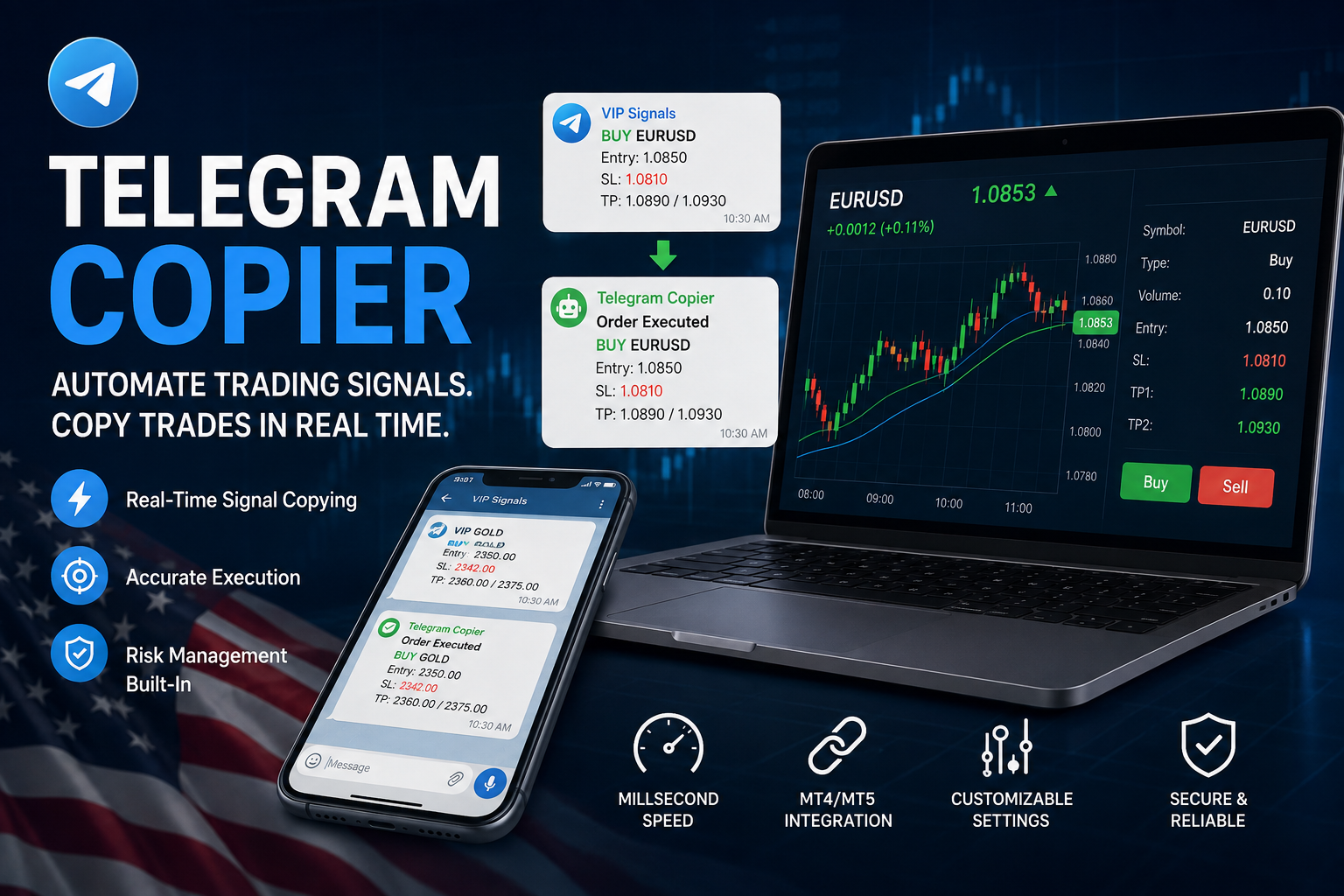
A Telegram Copier is designed to reduce the manual work involved in reading a trading signal on Telegram and entering the same order into a trading platform. For traders in the United States, however, speed is only one part of the decision. Signal quality, broker compatibility, execution settings, account security, risk controls, and the regulatory status of the people or firms involved can matter just as much.
The basic idea is straightforward. A signal provider publishes instructions such as an instrument, entry price, stop loss, take-profit levels, and sometimes position-management updates. Copier software reads that message, interprets the trading instructions, and converts them into an order that can be sent to a connected account.
The appeal is easy to understand. Manual copying can involve delays, typing errors, missed messages, and inconsistent position sizing. Automation can reduce some of those operational problems. However, it does not make a weak signal profitable, remove market risk, or guarantee that an order will execute at the price stated in a Telegram message.
This guide explains how Telegram copying works, what U.S. users should evaluate, how to configure a copier responsibly, and why due diligence still matters when trading decisions originate on social or messaging platforms.
Table of Contents
- What Is a Telegram Copier?
- How a Telegram Copier Works
- Why U.S. Traders Use Telegram Copiers
- Telegram Copier vs. Manual Signal Trading
- The Main Components of a Telegram Copier
- Understanding Telegram Signal Parsing
- Connecting Telegram Signals to MT4 or MT5
- Telegram Copier Risk Management
- A 10-Step Telegram Copier Setup Checklist
- Execution Speed, Slippage, and Real-World Results
- Security and Privacy Considerations
- U.S. Regulatory and Due-Diligence Considerations
- How to Evaluate Telegram Signal Providers
- Common Telegram Copier Mistakes
- What to Test Before Using Real Money
- People Also Ask
- Telegram Copier Q&A
- Conclusion
Featured Definition: What Is a Telegram Copier?
A Telegram Copier is software that reads trading signals sent through Telegram, identifies instructions such as the symbol, entry, stop loss, take profit, and trade direction, then automatically converts those instructions into orders for a connected trading platform. It reduces manual execution but does not remove trading or signal-provider risk.
How Does a Telegram Copier Work?
A Telegram Copier normally sits between two systems: Telegram and the trading platform.
On one side, it monitors selected Telegram chats, groups, or channels that the user is authorized to access. On the other side, it communicates with a trading environment such as MetaTrader 4 or MetaTrader 5.
The workflow typically looks like this:
Telegram message → signal parser → trading rules → position sizing → platform order → trade management
The important component is the parser.
A parser is software that turns an unstructured message into structured information. For example, consider a simplified signal:
BUY EURUSD
Entry: 1.0850
SL: 1.0810
TP1: 1.0890
TP2: 1.0930
A well-configured copier may identify:
- Direction: Buy
- Instrument: EUR/USD
- Entry: 1.0850
- Stop loss: 1.0810
- First target: 1.0890
- Second target: 1.0930
It can then apply the user’s own trading rules before sending an order.
Telegram provides APIs that developers can use to build software around Telegram messages and bots. Telegram describes its Bot API as an HTTP-based interface for developers building applications that interact through Telegram. Developers can also use Telegram’s broader API and TDLib for customized Telegram clients. See the official Telegram Bot API documentation for the underlying platform concepts.
Importantly, Telegram itself does not determine whether a trading signal is accurate or suitable. A copier automates instructions; it does not validate the investment thesis behind them.
Why U.S. Traders Use a Telegram Copier
For a U.S. trader following active signal channels, manual execution can become difficult.
A provider may issue a signal while the trader is working, sleeping, commuting, or away from the trading terminal. Moreover, the provider may later send a message such as “move SL to breakeven,” “close half,” or “cancel pending order.”
Therefore, automation may offer several operational benefits.
1. Faster reaction to signals
A copier can process a message much faster than a person who must unlock a phone, open a trading platform, locate the symbol, calculate position size, and enter the order.
However, faster does not automatically mean better.
The actual fill still depends on factors such as market liquidity, broker infrastructure, spreads, volatility, network latency, and whether the signal’s quoted price is still available.
2. Fewer manual-entry errors
Manual trading creates opportunities for simple mistakes.
For example, a trader may:
- enter 1.0 lot instead of 0.10;
- reverse a buy and sell;
- mistype the stop loss;
- choose the wrong symbol;
- miss a second take-profit target; or
- act on an outdated signal.
A Telegram Copier can reduce these mechanical errors when its parsing and trading rules are configured correctly.
3. Consistent risk rules
Automation can also make risk settings more consistent.
For instance, a trader may decide that every copied position should use a fixed lot size or a predefined percentage-risk calculation rather than blindly accepting sizing from a signal provider.
That distinction is important.
The signal can tell you what a provider wants to trade, while your copier settings determine how much risk your account accepts.
4. Easier management of multiple channels
A user may follow more than one Telegram signal source.
Therefore, a capable Telegram Copier may allow different rules by channel or instrument. Your site’s current product description, for example, highlights configurable parameters, per-channel/per-symbol lot controls, stop-loss and take-profit options, partial closes, and trailing-stop functionality. It also describes desktop operation with MT4 and MT5 integration.
Those controls are valuable because signal providers rarely have identical risk profiles.
Telegram Copier vs. Manual Signal Trading
The following comparison shows where automation can help and where human oversight still matters.
| Factor | Manual Signal Trading | Telegram Copier |
|---|---|---|
| Entry speed | Depends on trader availability | Can process signals automatically |
| Typing errors | Higher possibility | Reduced if parser is configured correctly |
| Position sizing | Calculated manually | Can use predefined sizing rules |
| Missed signals | Possible | Lower when software is running correctly |
| Multiple channels | Harder to manage | Can be automated by channel |
| Signal interpretation | Human judgment | Depends on parser rules |
| Bad signal protection | Trader may reject signal | Requires filters or manual approval settings |
| Internet/platform failure | Can interrupt trading | Can also interrupt automation |
| Market risk | Present | Still present |
| Slippage | Present | Still present |
| Oversight | Direct | Requires monitoring and testing |
Therefore, the main advantage of a Telegram Copier is execution automation, not investment intelligence.
A copier can faithfully execute a poor strategy just as efficiently as a strong one.
The Main Components of a Telegram Copier
Although products differ, a complete Telegram Copier usually needs several functional layers.
Telegram connection
First, the software needs a method for receiving messages from the Telegram environment.
Depending on the implementation, the software may use Telegram bot functionality, a Telegram account connection, or other Telegram API-based methods. Telegram distinguishes between its Bot API and the broader Telegram API/TDLib used for custom clients.
Signal parser
Next, the copier must understand what the message means.
This becomes harder than it sounds because signal providers rarely use one universal format.
One channel may publish:
“BUY GOLD NOW 2350 SL 2342 TP 2360/2375”
Another may publish:
“XAUUSD LONG
Entry zone 2348–2352
Stop 2340
Targets 2360, 2370, 2385”
The meaning may be similar, but the text structure is different.
Therefore, flexible parsing is one of the most important features in a Telegram Copier.
Trading-rule engine
After parsing the message, software needs rules governing what it is allowed to do.
For example:
- maximum lot size;
- fixed or dynamic position size;
- allowed instruments;
- ignored instruments;
- allowed trading hours;
- maximum number of open positions;
- stop-loss requirements;
- minimum or maximum stop distance;
- duplicate-signal handling; and
- channel-specific settings.
These safeguards matter because automation should not mean unrestricted execution.
MetaTrader connection
Finally, the copier needs a way to place or manage orders inside the trading platform.
Your product currently describes automatic copying of Telegram signals to MT4 or MT5 and states that its trading environment can run from a Windows, Mac, or Linux desktop setup.
Before relying on any platform combination, users should verify that their own broker, account type, instruments, symbol names, and execution rules are compatible.
Understanding Telegram Copier Signal Parsing
Parsing is often the difference between reliable automation and unexpected execution.
Suppose a provider writes:
“EURUSD BUY 1.0850-1.0860 SL 1.0820 TP 1.0900”
The software must answer several questions:
- Is 1.0850–1.0860 an entry zone?
- Should it use a market order?
- Should it create a pending order?
- Should it wait until the market enters the range?
- Is 1.0820 definitely a stop loss?
- Is 1.0900 the only take profit?
- What happens if the provider edits the message?
Now imagine a follow-up message:
“Close EURUSD. +30 pips.”
The copier also needs to know whether that refers to:
- every EUR/USD position;
- only the position opened from that Telegram channel;
- only the latest position; or
- a particular signal ID.
Therefore, users should test actual channel messages rather than assuming that a parser will understand every possible format.
Your site’s product description states that its signal parser is designed to handle varying signal formats and can be adjusted through the interface when required.
For practical use, I would treat parser configuration as part of the trading system itself. In other words, do not test only whether the copier can “see” a Telegram message. Test whether it interprets every important message type correctly.
Connecting Telegram Signals to MT4 or MT5
A Telegram Copier aimed at MT4 or MT5 users normally has three jobs:
- receive the Telegram message;
- translate the signal into standardized trade instructions; and
- transmit those instructions into the trading account.
The third step needs particular attention.
Different brokers may use different instrument labels. For example, one environment might display EURUSD, while another could append a broker-specific suffix.
Similarly, a signal may say “GOLD,” while the platform identifies the instrument differently.
Therefore, symbol mapping should be checked before live use.
The same principle applies to decimal precision, minimum position sizes, maximum position sizes, allowed stop distances, pending-order rules, and trading hours.
These are operational details rather than predictions about profitability.
Telegram Copier Risk Management
Risk controls are arguably more important than execution speed.
A Telegram Copier can process a message quickly, but the trader still needs to decide how much capital should be exposed to that idea.
Fixed lot sizing
A simple approach is to use the same lot size for every eligible signal.
For example:
- Signal provider says “Buy.”
- Telegram Copier receives the instruction.
- Your account always uses a predefined size.
This is easy to understand. However, the dollar amount at risk may change significantly when stop distances vary.
Risk-based position sizing
A more structured approach is to base size on the amount of account equity the trader is willing to risk.
Conceptually:
Risk amount ÷ trade risk per unit = position size
The exact calculation varies by instrument and account.
Therefore, users should verify calculations against their broker’s contract specifications rather than assuming one formula applies universally.
Maximum position size
Even when dynamic sizing is enabled, a maximum size can act as a safety ceiling.
That safeguard becomes especially useful when:
- a signal has an unusually tight stop;
- a parser reads a decimal incorrectly;
- account equity has changed;
- the channel posts an abnormal format; or
- the provider accidentally sends a malformed signal.
Mandatory stop loss
Another sensible control is requiring a valid stop loss before automatic execution.
That does not make a trade safe. However, it can prevent the copier from opening positions that do not satisfy your predefined risk rules.
Per-channel rules
A trader may trust one signal source more than another.
Therefore, the Telegram Copier can ideally treat channels separately.
For example:
- Channel A: normal risk.
- Channel B: half-size positions.
- Channel C: demo account only.
- Channel D: notifications only.
Your site’s current feature description includes channel-specific and symbol-specific lot controls as well as automatic SL/TP and trailing-stop options.
10-Step Telegram Copier Setup Checklist
Use this checklist before allowing fully automated execution.
- Confirm broker compatibility.
Verify that your chosen trading account and platform work with the copier. - Connect only the Telegram channels you intend to use.
Avoid granting unnecessary access or monitoring unrelated chats. - Collect real historical signal examples.
Include entries, cancellations, edited messages, stop changes, partial closes, and take-profit updates. - Configure symbol mapping.
Make sure names used in Telegram correspond to the correct symbols inside your trading platform. - Set position-size limits.
Never assume that the signal provider’s suggested lot size suits your account. - Configure stop-loss and take-profit behavior.
Decide whether the copier uses provider levels, your own rules, or a combination. - Set channel-specific limits.
Different signal sources should not automatically receive identical permissions. - Test on a non-live environment first.
Confirm message interpretation and order behavior without putting significant capital at risk. - Simulate unusual messages.
Test malformed signals, duplicate messages, edits, deleted messages, and unsupported instruments. - Monitor initial live execution carefully.
Automation still requires supervision, especially after software, broker, platform, or channel-format changes.
Execution Speed, Slippage, and Real-World Results
Speed is commonly highlighted when people search for Telegram Copier software.
It matters, but it needs context.
Suppose a signal says to buy an instrument at 1.1000. By the time the message reaches Telegram, the copier processes it, and the broker accepts the order, the market may be trading at 1.1003.
That difference is slippage.
Therefore, even extremely fast software cannot guarantee the price printed in a Telegram message.
The final execution price can depend on:
- when the provider generated the signal;
- when Telegram delivered it;
- network conditions;
- local computer or VPS performance;
- the copier’s processing time;
- broker infrastructure;
- market volatility;
- available liquidity; and
- the order type.
Your site’s current marketing emphasizes real-time, millisecond-oriented processing. That describes software-processing goals, but users should distinguish software speed from guaranteed broker execution or guaranteed market fills.
That distinction improves both user expectations and responsible product evaluation.
Security and Privacy Considerations
A Telegram Copier may interact with sensitive systems.
Therefore, security should be part of the purchasing decision rather than an afterthought.
Keep trading credentials protected
Users should understand where credentials are stored and transmitted.
Ideally, documentation should answer questions such as:
- Are credentials stored locally?
- Are they encrypted?
- Does a remote server receive them?
- Who can access them?
- What happens after uninstalling the application?
Your site’s current description states that the desktop application is designed to run locally and keep trading information on the user’s own device or VPS.
That architecture can reduce some forms of remote exposure, although users still need normal device-security practices.
Protect the computer itself
Local operation does not eliminate risk.
A compromised computer can still expose:
- Telegram sessions;
- passwords;
- trading-platform credentials;
- API credentials;
- copied signals; and
- account information.
Therefore, users should keep the operating system updated, use strong authentication, control remote access, and avoid installing untrusted software on the same machine.
Review software permissions
A trading automation tool should receive the permissions necessary to function—but no more than necessary.
In addition, users should understand whether the software needs access to an entire Telegram account or only particular communication paths.
U.S. Regulatory and Due-Diligence Considerations
For U.S. users, there are two separate questions:
- Does the software technically copy the signal?
- Who is providing the signal, trading service, brokerage access, or investment-related recommendation?
Those questions should not be confused.
A Telegram Copier is an automation tool. However, financial promotions, investment advice, discretionary account management, brokerage activity, and certain derivatives-related activities can involve separate U.S. regulatory requirements depending on the facts.
This section provides general administrative and due-diligence information, not legal advice. Businesses offering investment-related services should obtain guidance from qualified U.S. legal or compliance professionals regarding their specific activities.
Be cautious with social-media trading claims
U.S. regulators have repeatedly warned investors about investment promotions and trading services distributed through social media and messaging platforms.
For example, FINRA warns that unregistered entities have promoted auto-trading services to retail investors through social media while making potentially misleading claims about ease of use and risk. FINRA recommends checking the background and registration status of financial professionals and firms where applicable. See FINRA’s guidance on risks of auto-trading services offered by unregistered entities.
Likewise, the U.S. Securities and Exchange Commission has cautioned investors against making investment decisions solely because of stock recommendations distributed through social media or group chats. Its investor materials emphasize verifying the identity and credentials of people presenting themselves as financial professionals. See the SEC’s Social Media and Stock Tip Scams investor alert.
U.S. forex users should verify counterparties
This point is particularly relevant because many Telegram trading channels focus on forex.
The Commodity Futures Trading Commission warns that social media and messaging platforms are commonly used in forex-related fraud schemes. It specifically recommends caution around promises of unusually high or guaranteed returns and around unregistered dealers without a U.S. presence.
The National Futures Association also maintains its BASIC database, which U.S. users can use to research registration, membership, disciplinary, and related information for certain derivatives-industry firms and professionals.
Accordingly, choosing Telegram Copier software should never substitute for checking the trading provider, broker, or signal source itself.
How to Evaluate a Telegram Signal Provider
A copier only reproduces instructions.
Therefore, the quality and integrity of the source remain critical.
Look beyond screenshots
Screenshots can show selected winning trades without showing:
- losing trades;
- deleted signals;
- changed entries;
- widened stops;
- account drawdown;
- commissions;
- spreads;
- slippage; or
- abandoned strategies.
Instead, look for a consistent and verifiable record where possible.
Watch for guaranteed-return language
Statements such as:
- “guaranteed profits”;
- “zero-risk strategy”;
- “100% win rate”; or
- “you cannot lose”
should trigger additional scrutiny.
The CFTC specifically warns consumers about trading-bot and signal promotions that promise unrealistic or guaranteed returns. Automated technology cannot eliminate market uncertainty.
Understand the strategy
You do not need to become a quantitative researcher.
However, you should understand basic questions:
- What markets does the provider trade?
- How frequently?
- What is a normal stop distance?
- Are positions held during major news?
- Does the provider average into losses?
- Does it use martingale-style sizing?
- How many simultaneous trades can be open?
- Are signals market orders or pending orders?
If you cannot explain how the strategy can lose money, you probably do not yet understand its risk.
Telegram Copier Configuration: What Matters Most?
A long feature list can be attractive, but a few functions tend to matter most in daily use.
Reliable parsing
First, the software needs to understand the channels you actually follow.
A “universal” parser should still be tested against real examples because human-written messages can contain ambiguity.
Position-size control
Second, users need to control how large each copied position becomes.
The safest operational assumption is that a provider’s sizing should not automatically determine your account’s sizing.
Symbol-specific settings
Third, some instruments may require different treatment.
For example, a user may want:
- lower size for volatile instruments;
- certain symbols disabled;
- different maximum positions by instrument; or
- certain instruments copied only during specific sessions.
Trade-management commands
Finally, a useful Telegram Copier should handle more than entries.
Real signal channels may send:
- move stop;
- close half;
- close trade;
- take partial profit;
- cancel order;
- change target; or
- move to breakeven.
Test each command type before relying on it.
Common Telegram Copier Mistakes
Mistake 1: Going live immediately
A successful software installation is not the same as a successful trading configuration.
First, test the parser and trade-management behavior.
Mistake 2: Copying the provider’s lot size blindly
The provider’s account may be much larger or smaller than yours.
Therefore, the same lot size can create completely different risk.
Mistake 3: Ignoring signal edits
Some providers edit Telegram messages rather than sending a new message.
Your automation needs defined behavior for edits.
Mistake 4: Running several channels without exposure limits
Three separate channels can unknowingly send highly correlated trades.
As a result, what looks like three small positions may represent one large directional bet.
Mistake 5: Assuming every missed trade is a software problem
Signals can fail to execute for many reasons, including unsupported instruments, closed markets, account restrictions, invalid prices, stop-distance rules, connection interruptions, or broker rejections.
Good troubleshooting distinguishes each layer.
Mistake 6: Believing automation removes supervision
Automation changes the trader’s job.
Instead of manually entering every order, the trader must supervise:
- configuration;
- signal sources;
- account risk;
- logs;
- software uptime;
- broker connectivity; and
- unusual executions.
What to Test Before Using Real Money
Before allowing a Telegram Copier to control a meaningful live balance, create a small test plan.
Test normal entries
Send examples of:
- buy signals;
- sell signals;
- market entries;
- entry ranges; and
- pending orders.
Confirm that every field is interpreted correctly.
Test stop-loss behavior
Verify:
- original stop placement;
- stop updates;
- breakeven instructions;
- trailing-stop behavior; and
- what happens if no stop is provided.
Test take-profit behavior
If a provider uses multiple targets, decide whether the copier should:
- split the original position;
- partially close at targets;
- close everything at TP1; or
- use another predefined method.
Test cancellations
A signal provider might cancel a setup before the entry is triggered.
The copier should have a predictable response.
Test duplicates
Telegram channels sometimes repost signals.
Therefore, verify that duplicate messages cannot unintentionally produce duplicate trades unless that behavior is specifically desired.
Test downtime
Disconnect the internet briefly or restart the software.
Then determine:
- whether signals are recovered;
- whether old signals execute unexpectedly;
- whether open positions remain protected; and
- whether the user receives clear status information.
People Also Ask About Telegram Copier
Is a Telegram Copier legal in the United States?
Using automation software is not, by itself, a complete answer to whether every related activity is permissible. The relevant facts can include the instrument being traded, broker, signal provider, who controls the account, and whether someone is providing regulated financial services. U.S. users should verify counterparties and obtain qualified advice when required.
Can a Telegram Copier guarantee profitable trades?
No. A Telegram Copier can automate the execution of signals, but it cannot guarantee that those signals will be profitable. Markets move unpredictably, and regulators specifically warn against promotions that promise guaranteed or unrealistic trading returns.
Can Telegram signals be copied automatically to MT4 or MT5?
Yes, third-party software can be designed to interpret Telegram trading messages and send corresponding instructions to MetaTrader environments. The exact setup depends on the copier, broker, signal format, platform configuration, and account permissions. Your site’s product is specifically positioned around Telegram-to-MT4/MT5 automation.
Does a Telegram Copier work with every signal channel?
Not necessarily. Signal formats vary widely, so users should verify whether their copier can correctly interpret each channel’s entries, targets, stops, edits, and management messages. Flexible parser settings can improve compatibility, but testing remains essential.
Is automatic Telegram copying faster than manual trading?
It can reduce the human delay between receiving a signal and submitting an order. However, actual trade execution still depends on network conditions, market movement, broker processing, liquidity, and the availability of the quoted price.
How to Choose a Telegram Copier
Rather than selecting software based only on speed claims, evaluate the entire workflow.
A useful shortlist should include:
Parser flexibility: Can it interpret the channels you actually use?
MT4/MT5 integration: Does it work correctly with your trading environment?
Risk settings: Can you cap lot sizes and apply your own position-management rules?
Per-channel controls: Can different signal providers receive different settings?
Per-symbol controls: Can you restrict or modify trading behavior by instrument?
Trade management: Can the application understand stop moves, partial closes, cancellations, and target changes?
Local or remote architecture: Where are account credentials and Telegram session data stored?
Logs: Can you see what message was received, how it was interpreted, and what order action followed?
Failure handling: What happens when Telegram, the computer, platform, internet connection, or broker becomes unavailable?
Testing options: Can you validate the setup before exposing meaningful capital?
These questions are more useful than simply asking which Telegram Copier has the largest number of features.
Should a Telegram Copier Run Locally or on a VPS?
A local computer can work well if it remains powered on and connected during the times signals are expected.
However, some traders use a virtual private server, or VPS, because it can remain online independently of a home computer.
Each model has tradeoffs.
Home computer
Advantages include direct control and simplicity.
However, execution depends on:
- power;
- home internet;
- computer sleep settings;
- software updates; and
- the machine remaining online.
VPS
A VPS can provide continuous remote operation.
However, it introduces another system that must be secured, maintained, and monitored.
Your site’s current product positioning says its standalone desktop application can run on a user’s own computer or VPS while keeping trading data within that device environment.
For many users, the right choice depends less on geography and more on uptime, security, latency, and their ability to manage the machine.
Telegram Copier Q&A
1. What should happen if a Telegram signal arrives without a stop loss?
The copier should follow a rule you defined in advance rather than improvise. For example, you might reject signals without a valid stop, apply a predefined maximum-risk rule, or require manual approval. The key is preventing an incomplete message from silently creating unintended exposure.
2. How should a copier handle several take-profit levels?
There is no universal method. One system may divide a position into several portions, while another may partially close the original position as each target is reached. Users should confirm exactly how volume is divided and what happens to the remaining stop loss.
3. What happens when a signal provider edits a Telegram message?
That depends on the software. Some systems can detect edits, while others process only new messages. Therefore, test real edited-message examples before assuming an entry price, stop loss, or target will automatically update.
4. Can I use different risk settings for different Telegram channels?
A capable system can be designed that way, and channel-specific configuration is useful because different providers have different trading styles and risk profiles. For example, one channel could receive normal sizing while another is restricted to smaller positions or a demo account. Your site’s current feature list includes per-channel and per-symbol lot configuration.
5. What is the most important feature in a Telegram Copier?
Reliable interpretation plus strict risk controls is more important than any single headline feature. Fast execution has limited value if the copier misunderstands an entry, chooses the wrong instrument, duplicates a trade, or opens a position larger than intended.
Final Thoughts: Using a Telegram Copier Responsibly
A Telegram Copier solves a specific problem: turning Telegram trading messages into repeatable trading-platform actions without requiring the user to enter every instruction manually.
That can reduce execution delays, missed messages, and routine input errors. In addition, configurable lot sizing, stop-loss handling, take-profit rules, channel filters, symbol controls, and partial-close logic can make the automation more consistent.
However, automation does not determine whether a signal is good.
It also does not eliminate slippage, broker restrictions, market volatility, technology failures, fraudulent signal providers, or the possibility of losing money.
For U.S. users, due diligence deserves particular attention. Regulators including FINRA, the SEC, CFTC, and NFA provide resources intended to help investors research firms, evaluate investment promotions, and recognize warning signs involving social media, automated trading, forex, and trading signals.
Therefore, the better approach is to treat a Telegram Copier as execution infrastructure—not as a shortcut around research or risk management.
Test the signal parser. Verify symbol mapping. Define maximum position sizes. Require sensible stop rules. Review how edited messages and duplicate signals behave. Start cautiously. Most importantly, evaluate the signal provider and broker separately from the automation tool.
If your goal is to automate Telegram trading signals while keeping control over MT4/MT5 execution and risk settings, explore the Telegram-to-MT4/MT5 trade copying platform and evaluate its configuration options against your own broker, signal channels, and trading requirements.